The ongoing issues between China’s extensive “nine-dash line” maritime assertion and opposing claims from Southeast Asian contenders – Vietnam, Malaysia, the Philippines, and Brunei – have constantly been on the 10-nation bloc’s agenda. These concerns were briefly overshadowed by other regional turmoil for two years, notably the widespread conflict in Myanmar. However, recent wave of assertive “grey zone” activities by the Chinese Coast Guard in waters claimed by Vietnam and the Philippines has again brought the maritime dispute to the forefront of the bloc’s agenda.
On August 5, a vessel from the China Coast Guard interfered and used a water cannon against a supply boat chartered by the Philippine Navy near Second Thomas Shoal in the Spratly Islands. The attack resulted in the redirection of the supply boat and its mission to replenish stocks on the Sierra Madre, a deteriorated ship from the World War II period. The ship had been deliberately stranded in the shoal’s shallow waters since 1999. This event happened after a comparable incident in the same location during February, involving a Chinese Coast Guard vessel employing a military-grade laser.
Along with these incidents, the prior half-year has observed a surge in Chinese incursions in the water zones which are also argued by Vietnam. On August 28, Vietnamese fisherman reported that a Chinese vessel assaulted their fishing boat in the South China Sea using a high-pressure water cannon, resulting in injuries to two crew members.
President Joko Widodo of Indonesia is leading Southeast Asian leaders in their last summit of the year. This gathering is characterized by the lack of resolution for critical issues such as the deadly civil conflict in Myanmar, recurring disputes in the South China Sea, and the ongoing tensions between the U.S. and China.
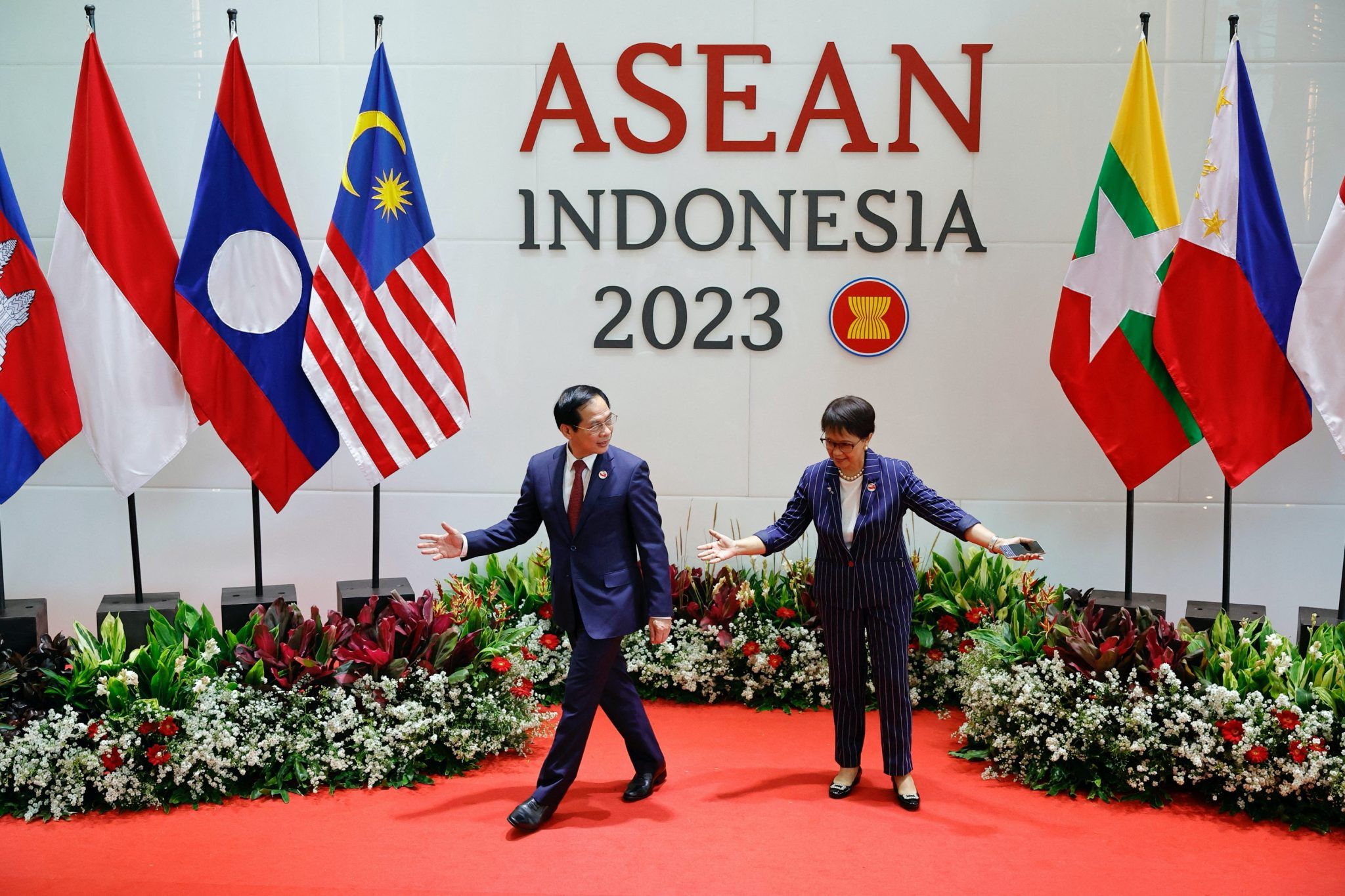
The Association of Southeast Asian Nations (ASEAN) meetings are set to start on Tuesday in Jakarta, Indonesia, with stringent security measures in place. Notably, U.S. President Joe Biden’s absence, who is usually present at such events, reinforces the already grave climate of ASEAN’s traditional display of unity and collective handshake among the 10 member states.
In the lead up to the leaders’ summit, ASEAN foreign ministers held a meeting on Monday. The situation was described by Indonesia’s Coordinating Minister for Political, Legal and Security Affairs, Mohammad Mahfud. He delineated the series of crises challenging the region’s capacity and resilience.
Mahfud expressed concern over the stagnant developments regarding the Myanmar crisis, stating that it has had a detrimental impact on ASEAN. He also cautioned about escalating geopolitical tensions and rivalries, ominously suggesting it could force the region into an open conflict.
Retno Marsudi, Indonesia’s Foreign Minister, advanced that the leaders’ five-point plan from 2021, designed to steer Myanmar back to normalcy, will be re-examined.
Following Tuesday’s discussions, the heads of states from ASEAN will convene with their Asian and Western peers from Wednesday to Thursday. This forms a broader stage that the U.S., China, and their allies have historically used for comprehensive discussions on free trade, climate change, and global security. The forum has also turned into an arena for their rivalries.
Chinese Premier Li Qiang is set to participate in the discussions, which includes attending the 18-member East Asia Summit. Here, Premier Li will come face-to-face with U.S. Vice President Kamala Harris, who will represent the U.S. in the absence of President Biden, and Russian Foreign Minister Sergey Lavrov.
Despite bypassing the ASEAN meetings, President Biden is scheduled to journey to Asia to attend the G20 summit in India, followed by a trip to Vietnam to boost relations. Washington has stated that the reason for Biden’s absence at the ASEAN meetings is not an indication of necessarily downgrading the bloc lower in geopolitical priorities. This is supported by the U.S. President’s attempts to strengthen America’s involvement with the region.
In a recent news briefing on Friday in Washington, John Kirby, a national security spokesperson, defended the administration’s interest and priority towards the Indo-Pacific region and Southeast Asia nations. Kirby countered the idea that the administration was neglecting these regions, citing their constant engagement since the start of their term.
The commitment of the Biden administration towards Southeast Asia was further demonstrated when President Biden himself attended the ASEAN summit meetings in Cambodia in November. He also hosted eight ASEAN leaders in May 2022 at the White House. These actions were taken, even amidst dealing with the Ukraine crisis induced by Russia’s invasion.
According to Kirby, the Biden administration is also intent on fortifying a network of security alliances across the Indo-Pacific, a move that includes Southeast Asia. While this strategic move is rooted in strengthening relations and security, it has been met with concern from China.
Marty Natalegawa, a highly esteemed ex-foreign minister of Indonesia, expressed his disapproval of Biden’s absence. However, he pointed out that such indicators were more worrisome as they reflect ASEAN’s decreasing significance.
Natalegawa stated in an interview with The Associated Press, “Whilst the U.S. President’s absence is disappointing and carries symbolic importance, it’s not my primary concern. I find the continuous pattern of ASEAN losing its prominence more troubling.”
Established in 1967 during the period of the Cold War, ASEAN adheres to a policy of non-interference in the individual domestic matters of its member countries. Moreover, its decisions are made by consensus, which means any single member holds the power to veto any decision or proposal they deem unsuitable.
The basic principles of the bloc have drawn an extremely diverse membership, spanning from emerging democracies to traditional monarchies. However, these same principles have hindered the bloc’s ability to penalize state-approved atrocities.
Currently, the group consists of Brunei, Cambodia, Indonesia, Laos, Malaysia, Myanmar, the Philippines, Singapore, Thailand, and Vietnam.
Natalegawa pointed out that the ASEAN’s inability to effectively control Myanmar’s military government regarding their human rights abuses, and its apparent lack of response to a recent incident involving a Chinese coastguard ship using a water cannon against a Philippine supply boat in the contested South China Sea, raises doubts about the group’s goal to be a key player in Asian diplomacy. He mentioned that member countries have sought either the U.S. or China for security.
[sourcelink link=”https://thediplomat.com/2023/09/asean-meetings-to-open-amid-growing-south-china-sea-tensions/”]