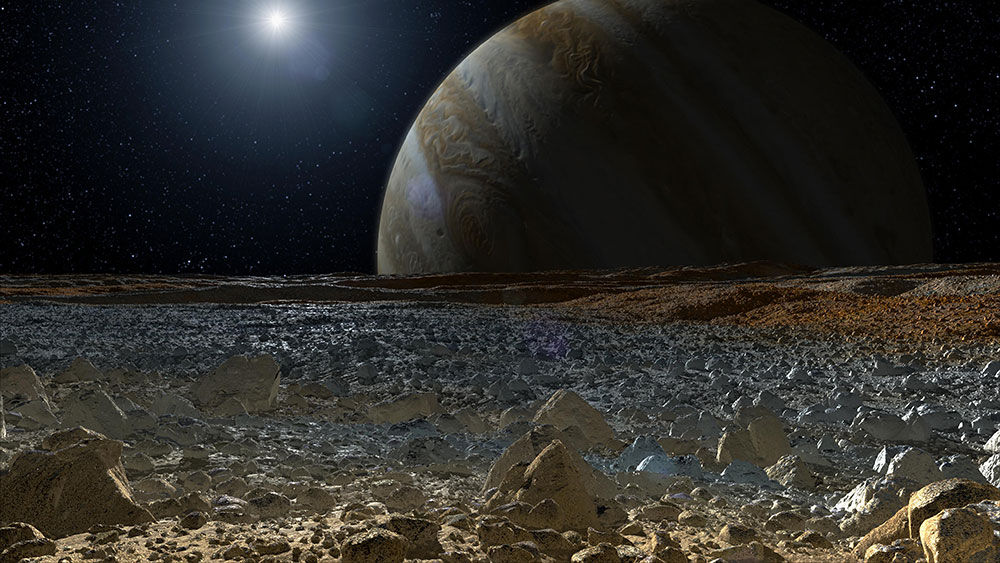
The James Webb Space Telescope (JWST) from NASA has made an interesting discovery on Jupiter’s icy moon Europa. It has found homemade carbon dioxide on this frigid waterworld, hinting at the possibility of hosting life. Europa, slightly smaller than Earth’s moon, is covered in a layer of water ice with an underlying saltwater ocean. The presence of liquid water has always intrigued scientists looking for signs of extraterrestrial life. However, no one had previously confirmed the existence of the essential building blocks of life, particularly carbon, in Europa’s ocean.
What makes this recent finding intriguing is that the carbon dioxide does not seem to have been brought by a meteorite or asteroid. Additionally, it was detected in a geologically young region of the moon called Tara Regio, suggesting that the gas may have originated within Europa itself. Previous observations using the Hubble Space Telescope had already shown evidence of ocean-derived salt in Tara Regio. These recent findings contribute to our growing understanding of Europa’s potential for hosting life.
Trumbo, the main author of one of the two papers discussing the recent Europa observations, got their work published in the renowned journal Science on September 21! Thanks to JWST’s incredible capabilities, researchers were able to gather insightful information about Europa in just a matter of minutes. As Heidi Hammel from the Association of Universities for Research in Astronomy stated, the observatory’s brief time usage helped uncover fresh details about the moon.
The scientists discovered evidence of both crystalline and amorphous carbon dioxide on Europa. (In simple terms, “amorphous” means a disorganized molecular form compared to the orderly patterns of crystals.) They detected high concentrations of carbon dioxide in what astronomers call “chaos regions,” where the outermost layer of the moon’s surface is disturbed, potentially allowing materials to move between the surface and the underlying ocean. Since carbon dioxide doesn’t remain stable for extended periods on Europa’s surface, the researchers believe that the carbon dioxide emerged from the ocean relatively recently. Based on recent research from 2022, Europa’s surface is estimated to be around 60 million years old on average, as indicated by the limited number of craters on the icy exterior. However, the chaos terrain is generally more youthful compared to the rest of the moon’s surface.
In the coming years, there are two exciting missions being planned for Europa. First up is NASA’s Clipper mission, set to blast off in 2024. This mission aims to observe Europa from orbit and has a special focus on uncovering molecules and conditions that could support life. On the other hand, the European Space Agency has already launched the Jupiter Icy Moons Explorer (JUICE) spacecraft in April. This awesome spacecraft will take its time and reach the gas giant in 2031. Once it’s there, it will perform a whopping 35 flybys of three fascinating moons: Europa, Ganymede, and Callisto. So get ready for some out-of-this-world discoveries!
[sourcelink link=”https://www.npr.org/2023/09/22/1201071390/carbon-jupiter-moon-europa”]
[sourcelink link=”https://www.theguardian.com/science/2023/sep/21/scientists-excited-to-find-ocean-of-one-of-jupiters-moons-contains-carbon”]