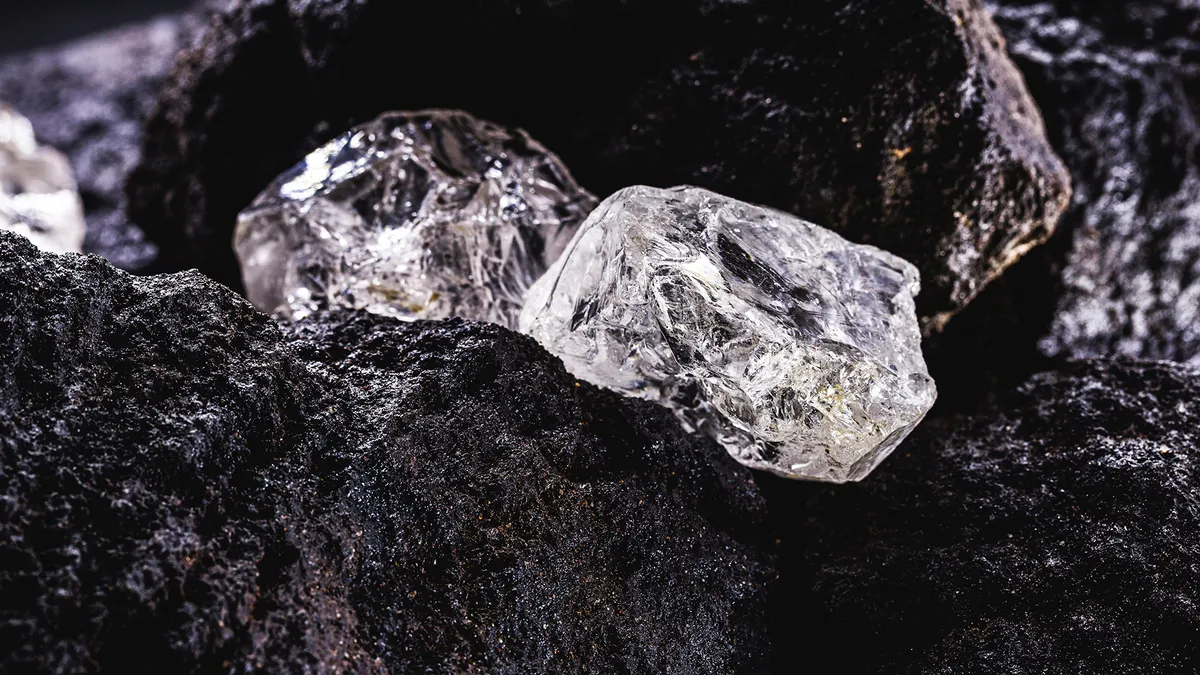
You won’t believe it, but scientists have figured out that diamonds don’t just form under high pressure deep in the earth. They literally rocket to the surface in crazy, massive volcanic eruptions!
Picture in your mind the breaking apart of supercontinents. This could actually set off these explosive eruptions, flinging a sprinkler’s worth of diamonds onto our surface.
Just to get a ballpark of how deep these sparkling gems come from, it’s around 93 miles (or 150 kilometers) down under in the Earth’s crust. They catch a ride to the top in speedy eruptions known as kimberlites.
These bad-boys move anywhere between 11 and 83 mph (18 to 133 km/h), and some may have even caused mega explosions similar to the big one at Mount Vesuvius, full of gases and dust clouds. That’s according to Thomas Gernon, a smart-cookie professor of Earth and climate science at the University of Southampton in England.
According to Gernon and his research team, a noticeable trend was detected where kimberlites, a rare type of igneous rock that sometimes yields diamonds, most frequently appear when tectonic plates are moving around big time. Interestingly, this happens when massive landmasses like Pangaea break up. But something doesn’t quite add up – kimberlites often turn up smack dab in the middle of continents, rather than on the outskirts where the split is happening. Plus, the crust in these areas is pretty thick, making it tough to disturb.
Gernon added, “Our diamonds have been hanging out at the base of our continents for hundreds of millions, even billions of years. But something must light a fire under them because when they do surface, it’s quite a show!”
The research team didn’t stop there. They examined the relationship between the age of the kimberlites and the level of plate fragmentation going on at the same time. They observed that in the last 500 million years, a sequence happened – the continental split would begin, and about 22 million to 30 million years after, the kimberlites would have a ‘blast off’ moment. Amazingly, this pattern has been consistent for the past billion years.
For example, the scientists discovered that the eruption of kimberlites – a type of volcanic rock – in areas that are currently Africa and South America surged around 25 million years following the fragmentation of the supercontinent named Gondwana, roughly 180 million years in the past. Moreover, there was a jump in kimberlite activity in modern-day North America after the colossal landmass of Pangaea started to crack around 250 million years ago. An intriguing finding was that these volcanic eruptions appeared to initiate at the fringes of the land splits and consistently headed toward the middle of these large land masses.
The team used an array of computer models to delve deeper into the driving forces behind these events, focusing on the elements beneath the earth’s surface like deep crust and the upper mantle. They discovered that as tectonic plates drift apart, the deepest layer of the continent’s crust becomes thinner, much like how the surface layer stretches to form valleys. The hot rock below the surface ascends, meets this new, thinner boundary, then cools down and descends again, leading to local circulation areas.
These unstable spots might start a chain reaction of instability in surrounding areas, slowly moving thousands of miles to the heart of the continent. This observation is in line with the real-world sequence of events seen in kimberlite eruptions that kick off near rift zones and later shift to the inner parts of continents, as stated by the scientists in a July 26 report in the journal Nature.
But what makes these instabilities ignite such powerful eruptions from the deep crust? According to Gernon, it’s a matter of mixing the perfect elements. These unstable conditions help the rock from the upper mantle and lower crust to rub against each other.
This mingles rock that has loads of water and carbon dioxide stuck within, plus an assortment of vital kimberlite minerals — diamonds too. The outcome is comparable to giving a champagne bottle a good shake, Gernon explained, leading to eruptions with a lot of firepower and the buoyancy to push them to the surface.
Gernon mentioned that their discoveries could come in handy when hunting for new diamond deposits. They could also help clarify why there are certain types of volcanic bursts that happen every now and then, long after a supercontinent has torn itself apart, in places that should be pretty stable.
He added, “This is a key and structured physical process, so it’s probably not just kimberlites reacting to this, but a lot of different Earth system processes might be feeling the impact of this too.”
[sourcelink link=”https://www.sciencetimes.com/articles/45538/20230822/diamond-triggering-eruptions-supercontinent-breakups-unleash-explosive-kimberlite-outbursts-earths.htm”]