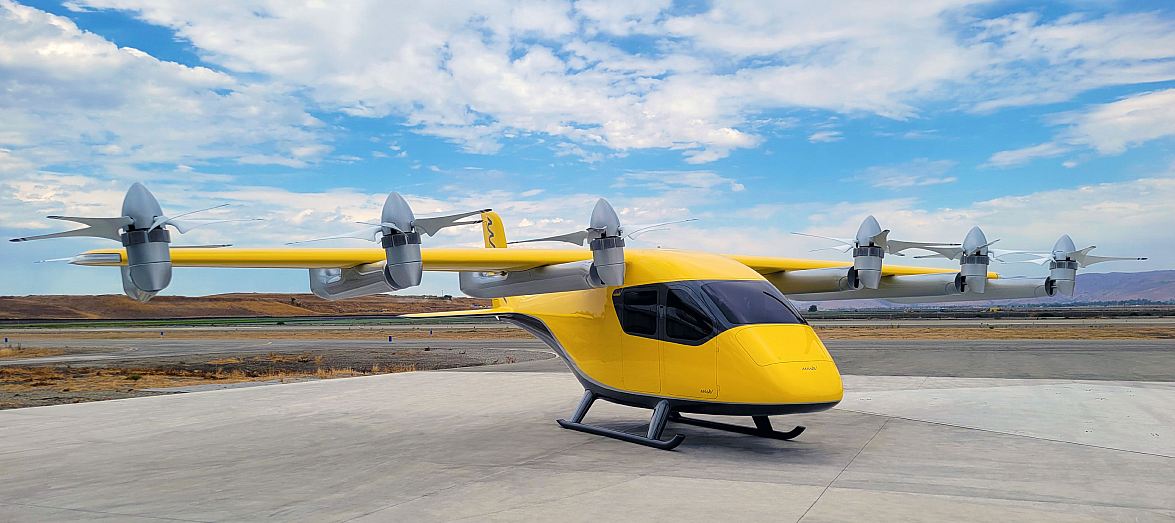
Over 200 companies are currently working on developing various types of aircraft, including multirotor copters and tilt-wing aircraft, that use electric vertical take-off and landing (eVTOL) technology. These smaller eVTOL craft allow pilots to land at conveniently located local ‘vertiports’ throughout the city.
The aircraft in development come in different sizes and have varying ranges, starting from two passenger eVTOL copters capable of flying 35 km (22 miles) like Volocopter from Germany, to larger fixed-wing craft like those being developed by Beta Technologies from the US, which can carry six people and have a range of 460 km (285 miles).
Air taxis are being hailed as the future of flying, with major investments from established aircraft manufacturers like Airbus and Boeing lending credibility to the concept. Airbus has created the CityAirbus NextGen, a speedy and quiet electric vertical takeoff and landing (eVTOL) vehicle that can seat four people.
Meanwhile, Boeing has invested $450 million in Wisk Aero, a startup focused on developing a self-flying two-seater. Air taxi services are expected to greatly reduce travel times between airports and city centers, and potentially offer fares as low as $1-2 per mile. This would provide passengers with a premium transportation option, minus the hassle of traffic congestion.
Autonomous planes are expected to gain popularity in the future as computer systems replace human pilots, creating more space for passengers. Wisk Aero’s CEO predicts that the autonomous air taxi market could be worth $4 trillion by 2035, with potential for city-to-city travel, cargo deliveries, and privately owned aircraft.
The emerging air mobility market has already attracted $8 billion in investments. However, the success of this industry relies heavily on the development of ground infrastructure, including vertiports. These vertiports, ranging from large urban hubs to small landing pads, may require new construction or retrofitting of existing buildings to accommodate eVTOL passengers and cargo.
UK startup urban-Air Port has an ambitious plan of setting up 200 hubs in 65 cities worldwide over the next five years. However, there are several challenges that must be overcome. These include the need to obtain certification for each aircraft, ensuring the safety of both the public and passengers, monitoring aircraft noise and noise pollution from vertiports, managing energy consumption, and reducing carbon emissions.
In February 2022, concerns about eVTOL safety were raised after a crash involving one of Joby Aviation’s autonomous test craft. To address this, authorities in the US and UK will collaborate on certification processes to guarantee the airworthiness of new aircraft. Furthermore, it will be crucial for aviation authorities to regulate the operation of vertiports to ensure their smooth functioning.
[sourcelink link=”https://www.cnbc.com/2022/12/03/how-electric-air-taxis-could-shake-up-the-airline-industry.html”]