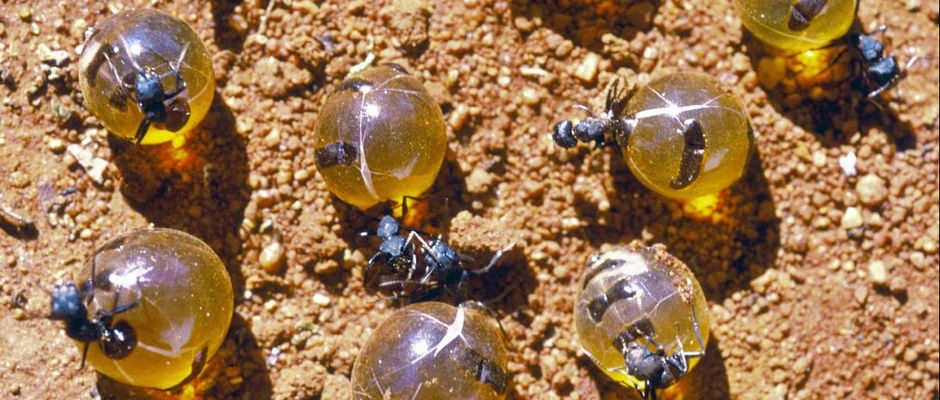
An odd Australian ant species makes honey with special antibacterial properties that destroy bacterial and fungal species.
The investigation on the therapeutic uses of ant honey is new, and it was carried out by researchers at the University of Sydney. However, this is not a new finding; in fact, First Nations people have been using Australian honeypot ants as food and medicine for thousands of years.
Western Australia’s and the Northern Territory’s arid regions are home to the Australian honeypot ant, Camponotus inflatus. The discovery of the specific antimicrobial components in ant honey is expected to aid in the creation of novel antibiotics, according to the researchers.
In the words of Andrew Dong, co-author of the study that was published in the journal PeerJ, “I have long been fascinated by the honeypot ant and its amazing way of producing and storing honey.”
“Given that Indigenous people have used honey as medicine, I wondered if it might have special antimicrobial properties.”
“Our people have been enjoying sweet honey ants for thousands of years,” said Danny Ulrich from the Tjupan linguistic group, who assisted the researchers in finding the honeypot ants. In terms of medicine, we apply it topically occasionally to stave off infections and for sore throats.
The scientists studied the honey’s bacterial and fungal microbiome, or the makeup of beneficial microbes that can combat harmful ones, following the example of Indigenous people. They discovered that golden staph, a bacterium that may cause illnesses or even death if it enters the body through a cut, can grow more slowly due to the honey’s microbiome.
The ants have additionally developed so that two fungus species, Aspergillus and Cryptococcus, which can also result in serious diseases in persons with weakened immune systems, are inhibited by their honey.
A peculiar role is played by one group of honeypot ants in the larger colony. The ‘rotunds’, or underground worker ants, are overfed by the other ants to the point where they are packed full of nectar and other sweet substances. As they fill up with honey, their abdomens turn translucent and orange and enlarge to the size of tiny grapes.
Due to their size, these ants become “vending machines,” regurgitating the honey for the other ants to consume on demand when food alternatives for the colony’s other ants become limited.
The researchers claim that their honey differs from manuka honey, a dark honey made by bees that pollinate manuka flowers that are indigenous to New Zealand, in that it has a different therapeutic mechanism. Due to its well-known antibacterial qualities, manuka honey is often used to treat wounds and skin infections.
[sourcelink link=”https://www.earth.com/news/ant-honey-may-be-the-secret-for-powerful-new-antibiotics/”]