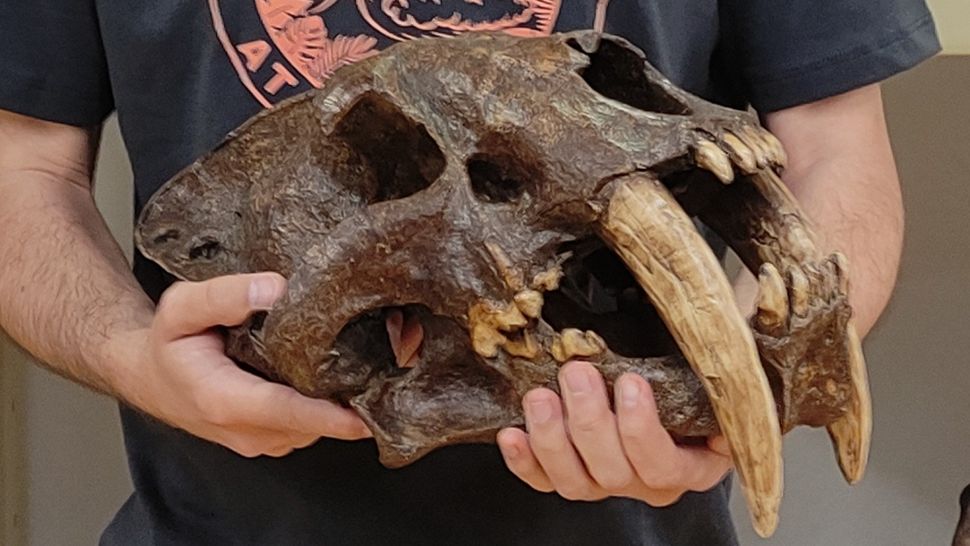
Two previously unknown species of saber-toothed cats that lived in Africa 5.2 million years ago have been discovered by scientists. According to a recent study, the results have altered what scientists previously believed to be true about this species of ancient feline.
The new discoveries may also provide insight into the environmental changes that were taking place at the time, which may help explain why early humans began to walk on two legs. say researchers.
Along with the bones of two other well-known species, Adeilosmilus kabir and Yoshi obscura, the partial remains of the two newly discovered species, Dinofelis werdelini and Lokotunjailurus chimsamyae, were discovered close to the town of Langebaanweg on South Africa’s west coast. The four species are members of the extinct subfamily Machairodontinae, which also includes the majority of the saber-toothed cat species. (The word Machairodontinae means “tooth with a dagger.”) Most species of this subfamily were comparable to most big cats in existence today in terms of size.
Researchers documented the remnants of all four species in a recent paper that was released on July 20 in the journal iScience. The team was not surprised to find D. werdelini because other species from this genus have been found in the region as well as in other parts of the world, including Europe, North America, and China. The discovery of L. chimsamyae, however, surprised the scientists because, up until this point, the genus’s only other known locations were Kenya and Chad.
According to the researchers’ results, the majority of saber-toothed cats may have been significantly more common than previously believed.
In order to establish a new family tree for the group, the researchers compared the bones of the recently discovered species with those of other known saber-toothed cats. Despite being in the same region at roughly the same period, the four species from Langebaanweg were not closely linked to one another and probably inhabited extremely diverse ecological niches.
For instance, L. chinsamyae and A. kabir were larger and better suited to sprinting quickly, making them suitable for open grassland habitats. However, the researchers noted that D. werdelini and Y. obscura were smaller and more nimble, which would have made them better adapted to covered habitats, like woods.
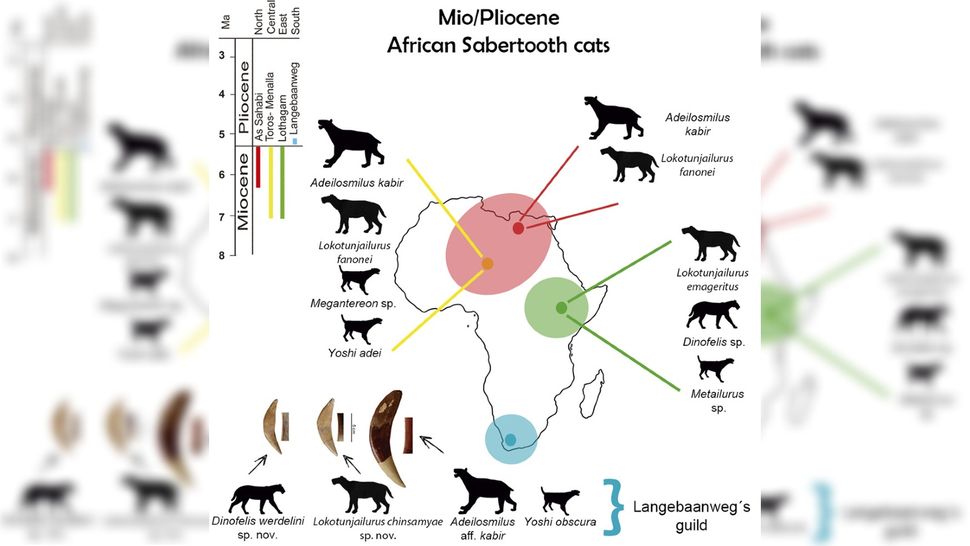
These species’ overlap shows that their habitat comprised both open grasslands and woods. The scientists hypothesize that this was caused by a change in Africa’s temperature, which gradually transformed the continent from a massive forest into open grassland, the most common habitat type today.
Researchers weren’t clear when the change in ecosystem type across Africa may have happened until recently. A deeper understanding of this may assist explain how hominins, the progenitors of modern humans who first appeared in Africa about this period, evolved into bipedalism. According to the study’s authors, the shift in the environment is likely to have been a “important trigger” that motivated hominins to stand on two legs.
Recent research, however, on other ancient habitats in Africa reveals that grasslands may have first appeared up to 21 million years ago, which raises the possibility that shifting ecosystems may not have had any impact at all on human bipedalism.
[sourcelink link=”https://www.livescience.com/animals/extinct-species/5-million-year-old-fossils-reveal-2-new-species-of-saber-toothed-cats-in-south-africa”]