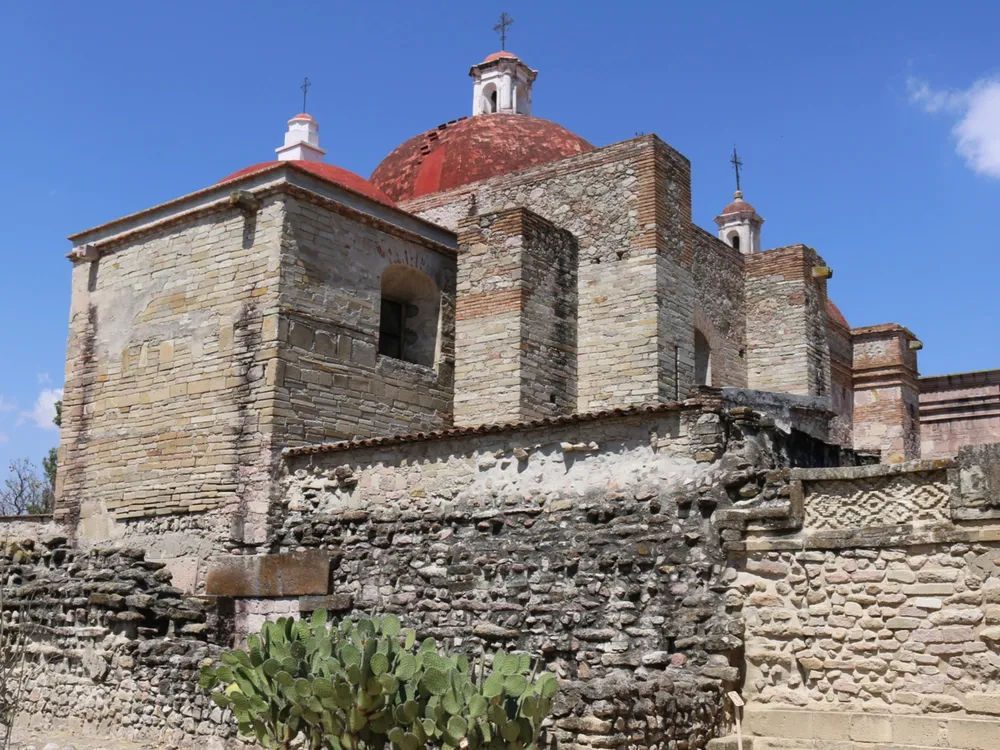
In southern Mexico, a deep earthen depression is said to have been the site of an elaborate network of tunnels constructed by the ancient Zapotecs who believed it to be the entrance to the underworld. The entrance, which is said to have been located beneath the Church of San Pablo, a Catholic church constructed in the 15th century, was later shut up by Spanish missionaries.
According to a statement from a group of researchers, a new examination has now shown that a sizable “underground labyrinth” of passages exists beneath the site.
Historical accounts support legends of the tunnels in addition to local folklore. In 1674, Francisco Burgoa, a Dominican chronicler, described a sizable earthen hollow at Mitla that a group of Spanish missionaries decided to investigate. According to a translation of Burgoa’s account, when they entered the maze, “such was the corruption and bad smell, the dampness of the floor, and a cold wind which extinguished the lights, that at the little distance they had already penetrated… they resolved to come out, and ordered this infernal gate to be thoroughly closed with masonry,” he wrote.
The tunnel system’s entrances were entirely blocked by the missionaries; the Zapotecs had given it the name Lyobaa, which means “place of rest.”
Project Lyobaa, a partnership between the National Autonomous University of Mexico, Mexico’s National Institute of History and Anthropology, and the ARX Project, is the new moniker for the group investigating Mitla’s mysteries.
/https://tf-cmsv2-smithsonianmag-media.s3.amazonaws.com/filer_public/80/ac/80acbb0d-b5ec-4f86-8d92-e48b0bf94630/mitla_imaging.jpeg)
By combining three geophysical scanning technologies—ground penetrating radar, electrical resistivity tomography, and seismic noise tomography—the researchers were able to generate a 3D model of Mitla’s underground tunnels while causing minimal damage to the archaeological site.
The researchers note that the scans discovered a “large void located right beneath the main altar” of the church. They also discovered a second “geophysical anomaly” north of the church and two other tunnels that were between 5 and 8 meters (about 16 and 26 feet) below the surface.
The ARX Project’s Marco Vigato tells Live Science’s Kristina Killgrove that the newly found chambers and tunnels “directly relate to the ancient Zapotec beliefs and concepts of the underworld and confirm the veracity of the colonial accounts that speak of the elaborate rituals and ceremonies conducted at Mitla in subterranean chambers associated with the cult of the dead and the ancestors.”
He continues by saying that although the researchers were expecting to locate the passageways, they were taken aback by their size. He claims that more investigation is necessary to precisely ascertain the size of these underground phenomena.
[sourcelink link=”https://www.smithsonianmag.com/smart-news/zapotec-underworld-entrance-mexico-180982552/”]