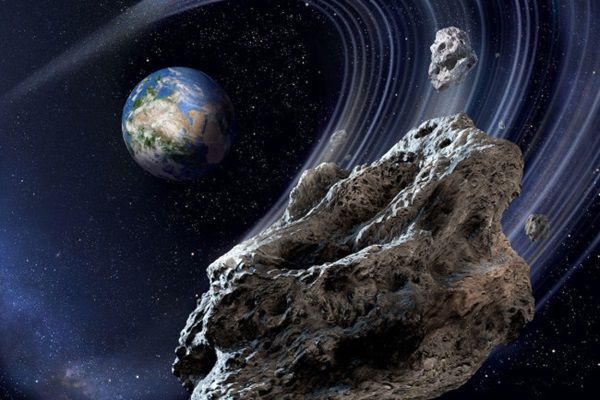
The Japanese space agency embarked on an exciting mission in 2018, known as Hayabusa2, which aimed to explore the asteroid Ryugu. As part of this remarkable mission, the spacecraft collected material from the asteroid’s surface, carefully sealed it in a container, and successfully transported it back to Earth. After a two-year journey, the precious sample touched down in the vast deserts of western Australia.
This significant retrieval marks a groundbreaking achievement as it contains an exceptionally pure sample of a carbon-rich asteroid. Scientists wasted no time and immediately embarked on studying this material, hoping to unravel the mysteries surrounding the history of our solar system. And now, the preliminary findings have emerged, suggesting that Ryugu might predate the existence of our own Sun.
One fascinating clue lies in the observation that Ryugu possesses an abundance of carbon and organic materials, unaffected by high temperatures. This implies that Ryugu must have originated in the outer regions of our solar system, possibly beyond Jupiter’s orbit. If it had formed closer to our young Sun, its chemical composition would have been altered due to partial melting.
Presolar grains are extremely scarce. Generally, they are discovered in carbonaceous chondrites, which make up only a small fraction of all meteorites landing on our planet. Moreover, presolar grains are only present in around 5 percent of carbonaceous chondrites. The oldest known presolar grain dates back to a staggering 5 to 7 billion years, surpassing the Sun’s age of 4.6 billion years.
These initial revelations provide us with intriguing new insights into the formation and evolution of celestial bodies within our solar system. The Hayabusa2 mission has truly pushed the boundaries of our knowledge and opened a new chapter in our understanding of the universe.
The second hint points out that a large amount of water can be found in the chemicals present in Ryugu. This suggests that the asteroid originally contained an abundance of water ice. However, if Ryugu had formed too close to the Sun, the intense heat would have caused the ice to evaporate, leaving no trace of water for it to combine with other chemicals.
For a long time, astronomers had speculated that asteroids like Ryugu formed in distant regions far from the Sun. However, there was no solid evidence to support this theory until now. The challenge lied in studying asteroid material, as it had to endure the high-speed journey through our atmosphere, causing significant changes to its composition. Hence, it was nearly impossible to determine the original nature of any asteroid studied. However, the case of Ryugu provides us with a unique opportunity to examine an unaltered sample firsthand.
Asteroids like Ryugu were created from the swirling disk of material that encircled the Sun long before it turned into a star. In fact, Ryugu likely came into existence even before the planets formed. However, right after its formation, it received a gravitational nudge from either Jupiter or Saturn. This push sent Ryugu and its fellow asteroids into the asteroid belt where they have peacefully resided for billions of years.
This is precisely why astronomers find these types of asteroids fascinating. They are like time capsules, granting us a glimpse into the early days of our solar system, before it even became what we know today.
[sourcelink link=”https://www.discovery.com/space/asteroid-ryugu-has-dust-grains-older-than-the-sun–how-“]