Chinese citizens have demonstrated their displeasure towards Japan with acts such as rock throwing at schools, boycott threats, and hostile phone calls. This anger arises from Japan’s recent release of treated wastewater from the Fukushima nuclear plant into the sea. Although the majority of scientists agree that the impact will be minimal, China has publicly expressed strong opposition to the release.
Reports indicate that no Japanese nationals or companies in China have been harmed. However, Tokyo has requested Beijing to ensure citizen safety. The Japanese foreign ministry has explicitly advised its citizens in China to be careful and avoid speaking Japanese loudly in public. China’s foreign ministry spokesperson, Wang Wenbin, responded that China always protects the safety and rights of foreigners in line with the law. He added that Beijing has acknowledged the “so-called concerns of the Japanese side.”
Chinese government disinforms Fukushima’s waste disposal plan.
A UK-based data analysis firm, Logically, has reported a disinformation campaign by the Chinese government and state media since January. The misinformation targets the release of nuclear waste water, which has been a contentious issue in the news outlets of China, often questioning its scientific backing. Public anger has noticeably surged since the release of the waste water on 24 August.
Since the beginning of the year, Logically’s data revealed that state-owned media have run advertisements on Facebook and Instagram, occluding disclaimers, about the risks of waste water release in several countries and languages. This included English, German and Khmer. Logically’s China expert, Hamsini Hariharan, shared with the BBC that the political motivation behind these actions is clear. She further added that misleading content, coming from sources related to the Chinese government, has led to intensified public outcry.
On Chinese social media, panicked individuals are buying large quantities of salt due to concerns over contamination from the upcoming Fukushima water release and false beliefs about salt as a protection against radiation. A restaurant in Shanghai is attempting to capitalize on these fears, promoting so-called “anti-radiation” meals, leading to ridicule from social media users questioning the high prices for ordinary dishes.
But hundreds rally in South Korea too against Fukushima wastewater release plan.
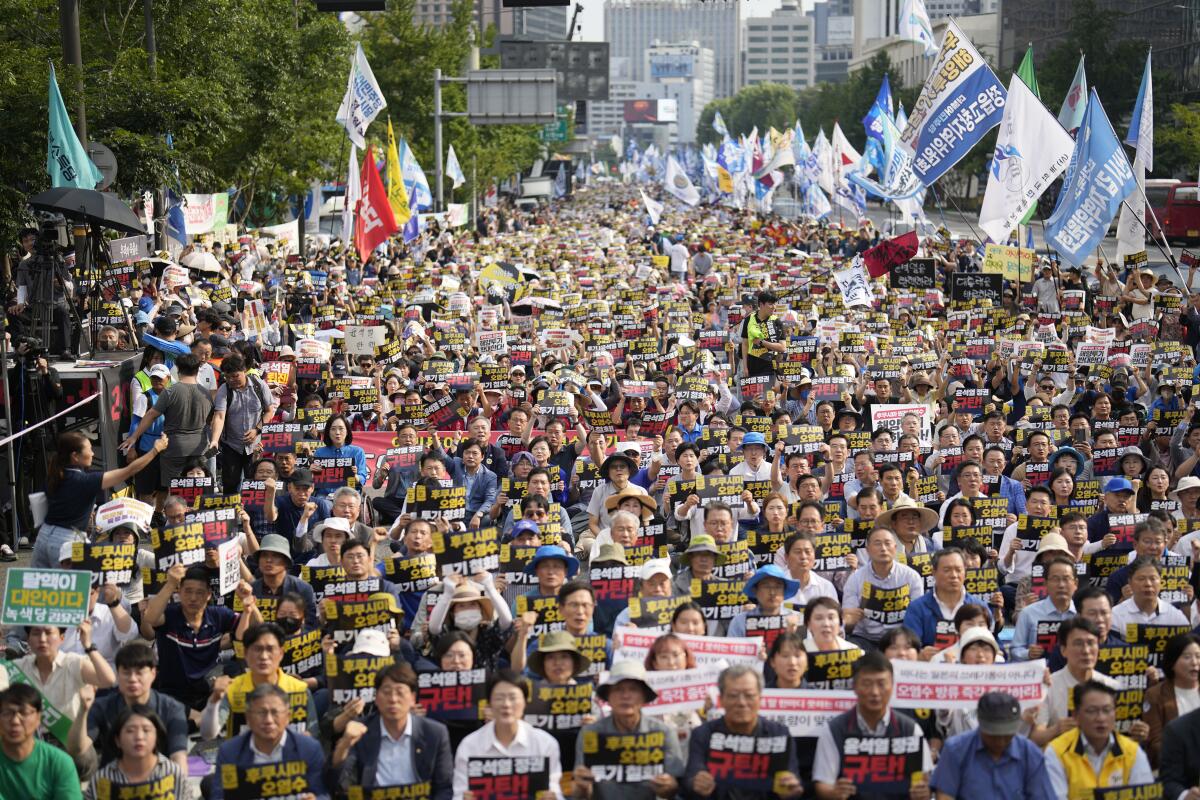
Hundreds of South Korean activists have protested in Seoul against Japan’s plan to release treated radioactive water from the damaged Fukushima nuclear power plant into the ocean, reports Al Jazeera. According to Japan’s Asahi Shimbun daily, the country may begin releasing the water as early as late August, said some anonymous government sources.
In the previous month, Tokyo Electric Power Company Holdings (TEPCO), the operator of a plant in Japan, received authorization from the country’s nuclear regulator to begin discharging the water. While Japan and the International Atomic Energy Agency (IAEA) have asserted the safety of this water, surrounding nations have voiced concerns over potential food contamination.
US President Joe Biden plans a trilateral summit with Japanese PM Fumio Kishida and South Korean President Yoon Suk-yeol on August 18. The summit may discuss the controversial issue of dumping contaminated water, which Choi suggests should be regarded as an environmental disaster instead of a political issue. He implores the governments to block such actions for the sake of future generations.
Evidently, the public’s memory remains haunted by the 2011 tsunami which impacted the Fukushima nuclear power plant in Japan, leading to the most severe nuclear catastrophe since the Chernobyl incident in the Soviet Union.
[sourcelink link=”https://www.bbc.com/news/world-asia-66667291″]
[sourcelink link=”https://www.aljazeera.com/news/2023/8/12/hundreds-rally-in-s-korea-against-fukushima-wastewater-release-plan”]