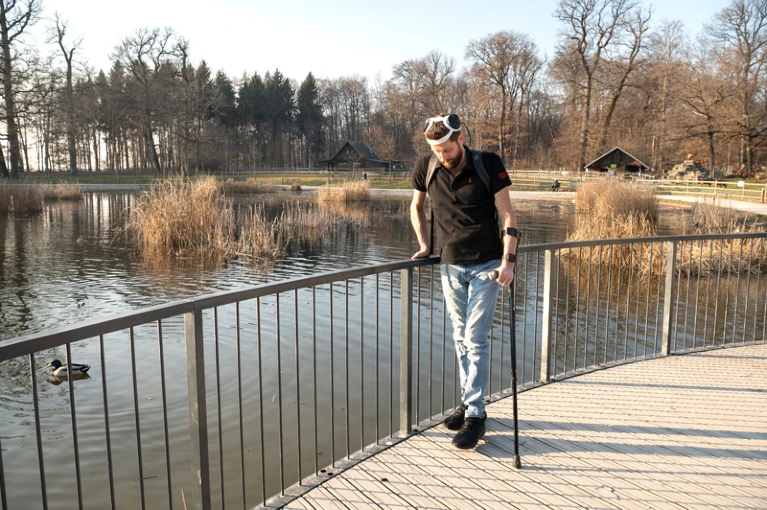
Thanks to electronic brain implants, a paralyzed man has been able to walk just by thinking about it; he claims that this medical first has revolutionized his life.
A bike accident left 40-year-old Dutchman named Gert-Jan Oskam paralyzed 12 years ago.
Through a second implant on his spine, the electronic implants wirelessly convey his thoughts to his legs and feet.
A renowned UK spinal charity deemed the device “very encouraging” despite the fact that it is still in the experimental stage.
Mr. Oskam told the BBC, “I feel like a kid learning to walk again”. He is now able to stand and ascend stairs.
Swiss experts were in charge of the development, which was published in the journal Nature. The neurosurgeon who performed the delicate surgery to put the implants, Prof. Jocelyne Bloch of Lausanne University, emphasized that the system was still in the basic research stage and was still many years away from being made available to patients who were paralyzed.
She did, however, tell BBC News that the team’s goal was to move it into the clinic as soon as possible after leaving the lab.
“The important thing for us is not just to have a scientific trial, but eventually to give more access to more people with spinal cord injuries who are used to hearing from doctors that they have to get used to the fact that they will never move again.”
The UK nonprofit organization Spinal Research, whose chief executive is Harvey Sihota, was not a part of the study. Although there was still a long way to go before the technology will be widely used, he hailed the advancement as “very encouraging”.
“While there is still much to improve with these technologies this is another exciting step on the roadmap for neurotechnology and its role in restoring function and independence to our spinal cord injury community”.
In July 2021, the procedure to regain Gert-Jan’s movement was completed. Prof. Bloch made two circular incisions on each side of his head, each measuring 5 cm in diameter, above the parts of the brain responsible for motor control. She then placed two implants into Gert-Jan’s head in the form of discs, which wirelessly transfer brain signals—the goals of Gert-Jan—to two sensors affixed to a helmet.
The Swiss researchers created an algorithm that uses a second implant placed around Gert-Jan’s spinal cord and Prof. Bloch’s meticulous attachment of the nerve endings related to walking to interpret these impulses into instructions to move the leg and foot muscles.
He was able to stand and walk with a walker after a few weeks of training, according to the researchers. According to Prof. Grégoire Courtine of the École Polytechnique Fédérale in Lausanne (EPFL), who oversaw the study, his movements are slow but fluid.
He commented, “Watching him walk so naturally is so moving.” It represents a paradigm leap from what was previously available.
The brain implants expand on Prof. Courtine’s earlier research, in which movement was solely restored using a spinal implant. Weak impulses from the brain to the injured portion of the spinal column were amplified by the spinal implant, and pre-programmed signals from a computer further enhanced the signals.
According to BBC News, David M’Zee was the first patient to receive a spinal implant in 2018 and was so successfully treated that he was able to have a child with his wife, which was previously impossible.
In addition, we previously covered Michel Roccati’s use of the same technology to regain his ability to walk after having his spine entirely severed.
Both have benefited greatly, although their walking style appears robotic and is pre-programmed. Additionally, they must keep their planned movements in time with the computer, stopping and starting again if they get out of pace.
Before receiving the brain implants, Gert-Jan only received the spinal implant. He claims that he has much more control now.
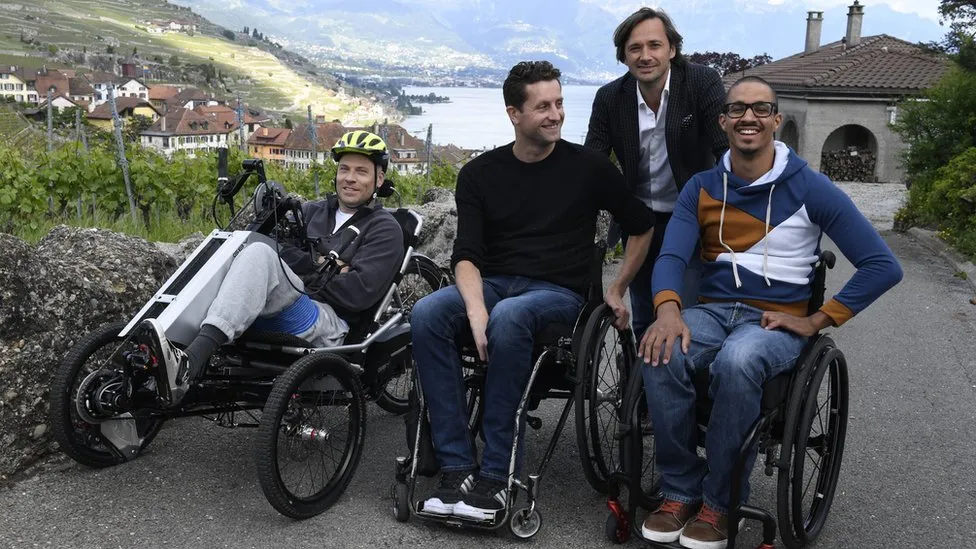
“I used to feel like the system was in charge of me, but now I’m in charge of the system.”Both the old and new systems cannot be used continuously. They are heavy and yet in the testing phase.
Instead, patients use them as part of their recovery for about an hour, a few times each week. Walking exercises their muscles and has helped them regain some movement when the system is turned off, which may be a sign that injured nerves are healing.
Miniaturization of the technology is the ultimate goal. The technology is being improved by Prof. Courtine’s spin-off firm, Onward Medical, in order to commercialize it and put it to use in people’s daily lives.
“It’s coming,” declares Prof. Courtine. “Ten years after his accident, Gert-Jan got the implant. Consider the time a few weeks following the accident when we will be using our brain-spine interface. There is great hope for improvement.
[sourcelink link=”https://www.nature.com/articles/d41586-023-01728-0″]